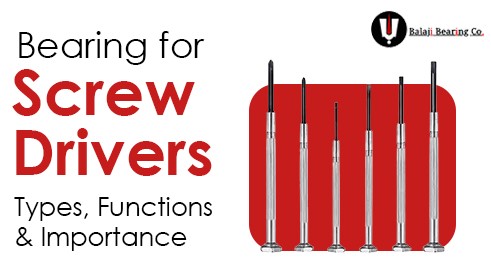
Screw drivers—especially electric and micro motor screw drivers—are precision tools widely used in electronics assembly, automotive manufacturing, medical device production, and light industrial applications. While motors and gear systems often get the most attention, the smooth performance and durability of a screw driver depend heavily on a small but vital component: the bearing.
What Is a Bearing for Screw Drivers?
A bearing for screw drivers is a mechanical component that supports the rotating motor shaft and gearbox inside the tool. Its main purpose is to allow smooth rotation while reducing friction between moving and stationary parts.
In electric and micro motor screw drivers, bearings ensure:
- Stable shaft rotation
- Accurate torque transmission
- Reduced vibration and noise
- Longer motor and gearbox life
Without proper bearings, screw drivers would suffer from poor efficiency, inconsistent fastening, overheating, and early failure.
Why Bearings Are Essential in Screw Drivers
Modern screw drivers operate at high speeds with precise torque control. Bearings play a key role by:
- Reducing friction and power loss
- Maintaining correct shaft alignment
- Supporting axial and radial loads during tightening
- Minimizing vibration and operational noise
In precision industries, even a small bearing defect can lead to damaged screws, stripped threads, or defective assemblies.
Types of Bearings Used in Screw Drivers
1. Miniature Deep Groove Ball Bearings:
These are the most commonly used bearings for screw drivers.
- Low friction and smooth operation
- High-speed capability
- Compact size
- Long service life
Electric screw drivers, cordless screw drivers, micro motor tools
2. Miniature Angular Contact Ball Bearings:
Used when both axial and radial loads are present.
- Higher precision
- Better axial load handling
- Improved torque stability
Precision screw drivers, electronics and medical assembly tools
3. Sleeve Bearings (Bushings):
Common in basic or low-cost screw drivers.
- Simple and economical
- Suitable for low-speed, low-load applications
- Higher friction
- Shorter lifespan
- Not ideal for precision tools
4. Ceramic or Hybrid Bearings:
Used in advanced or high-performance screw drivers.
- Extremely low friction
- Low noise and vibration
- Excellent high-speed performance
High-end micro motor screw drivers, automated assembly systems
Functions of Bearings in Screw Drivers
1. Reducing Friction for Smooth Rotation:
Bearings replace sliding contact with rolling motion, allowing the motor shaft to rotate smoothly and efficiently.
2. Maintaining Shaft Alignment:
Proper alignment ensures accurate torque delivery and prevents wobbling or runout that can affect fastening quality.
3. Supporting Axial and Radial Loads:
During operation, screw driver bearings handle:
- Radial loads from motor and gear rotation
- Axial loads from pushing the screw into material
4. Improving Torque Accuracy:
Smooth bearing operation ensures consistent torque, preventing over-tightening or under-tightening.
5. Reducing Noise and Vibration:
High-quality bearings absorb micro-vibrations, improving operator comfort and tool control.
6. Extending Tool Life:
By minimizing wear and heat, bearings protect motors and gears, extending the overall life of the screw driver.
Importance of Bearings in Micro Motor Screw Drivers
Micro motor screw drivers operate at very high RPMs and tight tolerances. Bearings are especially important because they:
- Support high-speed rotation
- Maintain precision under continuous use
- Prevent overheating in compact motor designs
In electronics and medical device assembly, bearing performance directly impacts product quality and production efficiency.
Industries That Rely on Precision Screw Driver Bearings
Bearings for screw drivers are widely used in:
- Electronics and PCB assembly
- Mobile phone and laptop manufacturing
- Medical and dental equipment production
- Automotive electronics
- Precision instrument manufacturing
In these industries, bearing reliability is critical to maintaining consistent assembly standards.
Benefits of Using High-Quality Bearings in Screw Drivers
| Feature | Benefit |
|---|---|
| Low Friction | Improved efficiency and power savings |
| High Precision | Accurate and consistent fastening |
| Load Capacity | Protects motor and gearbox |
| Low Noise | Better operator comfort |
| Long Service Life | Reduced maintenance and downtime |
Conclusion
Bearings play a crucial role in screw drivers, influencing smooth rotation, torque accuracy, vibration control, and tool durability. From basic electric tools to high-precision micro motor screw drivers, the right bearing selection ensures reliable performance and long service life. Investing in high-quality bearings leads to better fastening accuracy, higher productivity, and lower maintenance costs, making them an essential component in modern screw driver design.
Talk to Our Experts for Bearing for Screw Drivers Requirements
At Balaji Bearing India, we help you select the right Bearing for Screw Drivers for demanding applications. Get in touch with our experts for dependable and efficient solutions.
Email: balajibearingco.16@gmail.com for a quote.
Website https://balajibearingindia.in/
You can reach out directly to inquire or request a quote for Bearing for Screw Drivers.