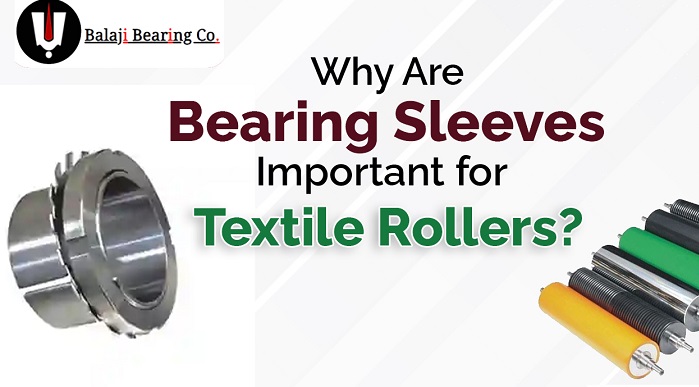
Textile manufacturing relies on continuous, high-speed operations where precision and reliability are critical. Textile rollers-used in spinning, weaving, knitting, and finishing processes-must run smoothly to maintain fabric quality and production efficiency. One often overlooked but essential component in these systems is the bearing sleeve.
What Is a Bearing Sleeve?
A bearing sleeve is a cylindrical component installed between the bearing and the shaft or housing. In textile roller applications, bearing sleeves are used to:
- Provide a precise fit between shaft and bearing
- Protect shafts from wear and damage
- Ensure correct alignment of rollers
These components are commonly made from hardened steel or specially treated alloys for durability.
Operating Conditions of Textile Rollers
Textile rollers operate under demanding conditions such as:
- Continuous high-speed rotation
- Variable radial loads from fabric tension
- Frequent start-stop cycles
- Exposure to fibers, lint, dust, and humidity
These conditions can cause premature wear if bearings are mounted directly on the shaft without proper support.
Why Bearing Sleeves Are Critical for Textile Rollers
1. Accurate Shaft and Bearing Fit:
Bearing sleeves ensure a uniform and precise fit between the shaft and the bearing inner ring. This prevents looseness or excessive interference, which can lead to vibration and uneven roller rotation.
2. Improved Load Distribution:
Textile rollers experience fluctuating loads depending on fabric type and tension. This component helps distribute these loads evenly across the bearing, reducing localized stress and extending bearing life.
3. Protection of Shaft Surfaces:
Without Bearing Sleeves, direct contact between the bearing and shaft can cause wear, fretting, or scoring. These parts act as a sacrificial wear layer, protecting the shaft from damage and reducing maintenance costs.
4. Easier Installation and Replacement:
Bearing sleeves simplify mounting and dismounting of bearings. This is especially valuable in textile plants where:
- Downtime must be minimized
- Rollers are replaced frequently
Damaged sleeves can be replaced without reworking the shaft.
5. Improved Alignment of Textile Rollers:
Proper alignment is essential for uniform fabric movement. Bearing sleeves help maintain:
- Correct roller positioning
- Stable rotation without wobble
This ensures consistent fabric quality and reduces defects.
6. Reduced Vibration and Noise:
By ensuring accurate fits and smooth rotation, this component reduces vibration and noise-important for both machine performance and operator comfort.
Common Textile Applications Using Bearing Sleeves
Bearing sleeves are widely used in:
- Spinning and winding machines
- Loom rollers and guide rollers
- Dyeing and finishing machines
- Printing and coating rollers
- High-speed textile processing equipment
In all these applications, reliable roller performance is critical.
Benefits of Using Bearing Sleeves in Textile Machinery
| Feature | Benefit |
|---|---|
| Precise fit | Stable roller rotation |
| Shaft protection | Lower maintenance cost |
| Easy replacement | Reduced downtime |
| Load distribution | Longer bearing life |
| Vibration control | Better fabric quality |
Conclusion
Bearing sleeves play a vital role in textile roller performance by ensuring accurate bearing fit, protecting shafts, improving load distribution, and reducing vibration. In high-speed textile machinery, these benefits directly translate into better fabric quality, longer equipment life, and reduced downtime. For textile manufacturers aiming to improve productivity and consistency, bearing sleeves are a simple yet highly effective solution.
Talk to Our Experts for Bearing Sleeves Requirements
At Balaji Bearing India, we help you select the right Bearing Sleeves for demanding applications. Get in touch with our experts for dependable and efficient solutions.
Email: balajibearingco.16@gmail.com
Website: https://balajibearingindia.in/
You can reach out directly to inquire or request a quote for Bearing Sleeves.