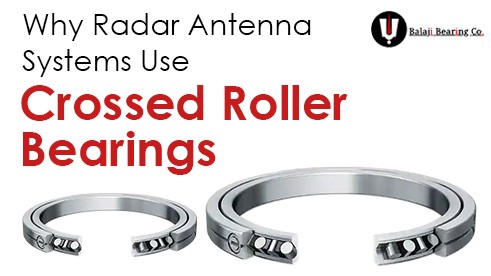
Radar antenna systems are precision-engineered structures designed to detect, track, and monitor objects with extreme accuracy. Whether used in defense, aviation, weather monitoring, or satellite communication, radar antennas must rotate smoothly, handle heavy loads, and maintain precise positioning under harsh environmental conditions. One key component that enables this level of performance is the crossed roller bearing.
What Are Crossed Roller Bearings?
Crossed roller bearings are high-precision rolling bearings in which cylindrical rollers are arranged orthogonally (at 90° to each other) between inner and outer rings. This unique configuration allows the bearing to:
- Handle radial, axial, and moment loads simultaneously
- Maintain high rotational accuracy
- Provide exceptional rigidity in a compact design
Unlike conventional bearings, crossed roller bearings often replace multiple bearing arrangements with a single, space-saving solution.
Performance Requirements of Radar Antenna Systems
Radar antenna systems operate under demanding conditions:
- High precision rotation for accurate target tracking
- Heavy combined loads due to antenna weight and wind forces
- Tilting and overturning moments
- Continuous or intermittent rotation
- Exposure to extreme weather, vibration, and temperature changes
Any deviation or instability can result in signal distortion, tracking errors, or system failure. These bearings are specifically designed to meet these challenges.
Key Reasons Radar Antenna Systems Use Crossed Roller Bearings
1. High Positional Accuracy and Smooth Rotation
Radar antennas Radar antennas require precise angular positioning for accurate signal transmission and reception.
- Provide near-zero clearance
- Maintain precise rotational accuracy
- Enable smooth, stable antenna movement
This precision is essential for high-resolution radar imaging and tracking accuracy.
2. Ability to Handle Combined Loads
Radar antennas are subjected to:- Radial loads from antenna weight
- Axial loads from mounting orientation
- Moment loads caused by wind pressure and rapid movement
Crossed roller bearings are uniquely capable of supporting all these loads simultaneously, making them ideal for radar pedestal and turntable applications.
3. Exceptional Rigidity and Structural Stability
The orthogonal roller arrangement provides:- High axial and radial stiffness
- Resistance to deformation under load
- Stable positioning even under dynamic forces
High rigidity ensures the antenna remains perfectly aligned, preventing signal loss or calibration drift.
4. Compact Design for Space-Constrained Systems
Radar systems often have limited space within their housings.
Crossed roller bearings:- Combine multiple load-handling capabilities into one bearing
- Eliminate the need for separate thrust and radial bearings
- Reduce overall system size and weight
This compactness is critical for mobile radar units, naval vessels, and airborne platforms.
5. Resistance to Vibration and Environmental Stress
Radar installations are frequently exposed to:- Strong winds
- Mechanical vibration
- Temperature fluctuations
- Continuous outdoor operation
- Minimize vibration transmission
- Maintain smooth motion under environmental stress
- Offer long service life with minimal maintenance
This reliability ensures consistent radar performance in all conditions.
Typical Applications in Radar Antenna Systems
Crossed roller bearings are commonly used in:
1.Antenna Pedestals:
Supporting rotation and tilting motions
2.Turntables and Positioners:
Ensuring accurate azimuth and elevation control
3.Tracking Radar Systems:
Maintaining precise alignment during rapid target tracking
4.Weather and Surveillance Radar:
Handling continuous operation and environmental exposure
5.Naval and Defense Radar Platforms:
Managing heavy loads and shock resistance
In each case, these bearings provide the precision, rigidity, and load capacity required for reliable radar operation.
Advantages of Crossed Roller Bearings in Radar Systems
| Feature | Benefit |
|---|---|
| Multi-Directional Load Handling | Supports radial, axial, and moment loads |
| High Rotational Accuracy | Ensures precise antenna positioning |
| High Rigidity | Maintains alignment under heavy loads |
| Compact Design | Saves space and reduces system complexity |
| Long Service Life | Reduced maintenance and downtime |
These advantages make crossed roller bearings an industry-standard choice for radar antenna systems.
Conclusion
Radar antenna systems rely on crossed roller bearings because they deliver unmatched precision, rigidity, and multi-directional load capacity in a compact design. By ensuring smooth rotation, accurate positioning, and resistance to environmental stress, these bearings play a critical role in radar system performance and reliability. For applications where accuracy and stability are non-negotiable, these bearings remain the preferred bearing solution in modern radar antenna systems.
Talk to Our Experts for Crossed Roller Bearings Requirements
At Balaji Bearing India, we help you select the right Crossed Roller Bearings for for demanding applications. Get in touch with our experts for dependable and efficient solutions.
Email: balajibearingco.16@gmail.com
Website https://balajibearingindia.in/
You can reach out directly to inquire or request a quote for Crossed Roller Bearings.