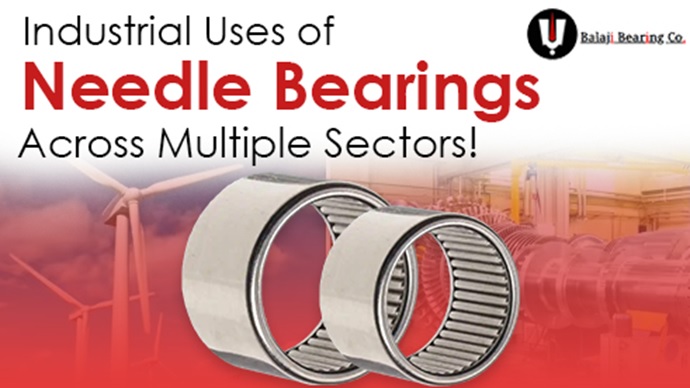
Needle bearings play a critical role in modern industrial machinery where space constraints, high load capacity, and precision performance are essential. Known for their compact design and exceptional load-handling capabilities, needle bearings are widely used across multiple sectors-from automotive and manufacturing to aerospace and energy. As industries evolve toward higher efficiency and durability, the industrial demand for needle bearings continues to grow.
What Are Needle Bearings?
Needle bearings are a type of roller bearing that uses long, thin cylindrical rollers, known as needles, instead of balls. These rollers have a high length-to-diameter ratio, allowing the bearing to support heavy radial loads while occupying minimal space.
Because of their slim profile and high load capacity, needle bearings are ideal for applications where compact design and durability are essential.
Key Advantages of Needle Bearings in Industrial Applications
Needle bearings offer several performance advantages that make them suitable for demanding industrial environments:
- High radial load capacity
- Compact and lightweight design
- Reduced friction under heavy loads
- Excellent durability and wear resistance
- Smooth operation in oscillating or rotational motion
These benefits make needle bearings indispensable in machinery requiring precision and reliability.
Industrial Uses of Needle Bearings Across Multiple Sectors
1. Automotive Industry
The automotive sector is one of the largest consumers of needle bearings. They are commonly used in:
- Transmissions and gearboxes
- Clutch assemblies
- Steering systems
- Universal joints and drive shafts
Needle bearings help improve fuel efficiency, reduce vibration, and ensure smooth power transmission, making them essential in both passenger vehicles and commercial trucks.
2. Manufacturing and Heavy Machinery
In manufacturing plants and heavy machinery, needle bearings are widely used in:
- Gear drives
- Conveyor systems
- Printing and packaging machines
- Industrial presses
Their ability to handle high loads in limited spaces allows manufacturers to design compact yet powerful machines with longer service life and reduced maintenance requirements.
3. Construction and Earthmoving Equipment
Construction machinery operates in harsh conditions involving dust, vibration, and heavy loads. Needle bearings are used in:
- Excavators
- Loaders
- Cranes
- Hydraulic systems
Their rugged construction ensures reliable performance even in challenging environments, reducing downtime and increasing equipment productivity.
4. Aerospace and Defense Sector
In aerospace and defense applications, precision and reliability are critical. Needle bearings are used in:
- Aircraft control systems
- Landing gear assemblies
- Actuation mechanisms
Their lightweight design and high load-carrying capacity help meet strict performance and safety standards while minimizing overall system weight
5. Power Generation and Energy Sector
Needle bearings support smooth and efficient operation in power generation equipment, including:
- Wind turbines
- Generators
- Turbines
- Compressors
Their low friction and durability help maintain consistent performance under continuous operation, contributing to higher energy efficiency and reliability.
6. Agricultural Machinery
Agricultural equipment requires components that can withstand heavy loads and variable operating conditions. Needle bearings are commonly used in:
- Tractors
- Harvesters
- Gear drives
- Power take-off (PTO) systems
These bearings help reduce wear, improve efficiency, and extend machine life in demanding farming environments.
7. Robotics and Industrial Automation
With the rise of Industry 4.0, needle bearings are increasingly used in:
- Robotic arms
- Automated assembly lines
- Precision motion systems
Their compact size and high accuracy make them ideal for high-speed and precision-driven automation applications
Types of Needle Bearings Used in Industry
Different industrial needs require specific needle bearing designs, including:
- Drawn cup needle bearings
- Machined needle roller bearings
- Needle roller and cage assemblies
- Combined needle bearings (radial and thrust)
Each type is engineered to meet specific load, speed, and space requirements
Maintenance and Longevity Considerations
Proper lubrication and installation are critical to maximizing the service life of needle bearings. Regular inspection, contamination control, and correct alignment help prevent premature wear and ensure consistent performance across industrial applications.
Challenges and Future Trends in Needle Bearing Technology (2026)
As industrial requirements evolve, needle bearing technology is advancing through:
- Improved materials for higher load capacity
- Advanced surface coatings for reduced friction
- Enhanced sealing solutions for harsh environments
- Smart bearings with condition monitoring capabilities
By 2026, needle bearings will play an even more significant role in automation, electric vehicles, and sustainable industrial systems.
Conclusion
The industrial uses of needle bearings across multiple sectors highlight their importance in modern engineering and manufacturing. Their compact design, high load capacity, and reliability make them indispensable in automotive, construction, aerospace, energy, and automation industries.
As technology advances, needle bearings will continue to evolve, supporting smarter, more efficient, and more durable industrial machinery worldwide.
📞 Reach out to Balaji Bearing India to source premium Needle Bearings ideal for automotive, industrial, and transmission applications.
Email: balajibearingco.16@gmail.com
Website: https://balajibearingindia.in/
You can reach out directly to inquire or request a quote for Needle Bearings.