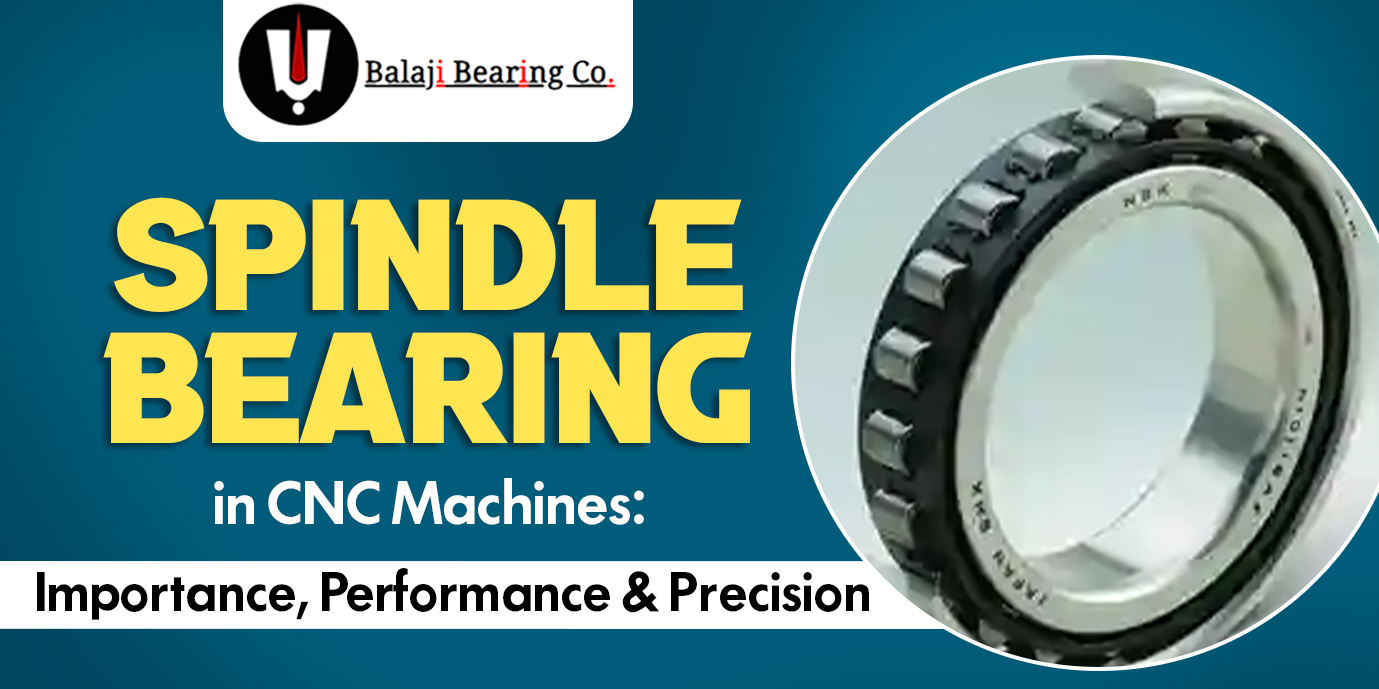
Spindle bearings are the heart of CNC machines, directly influencing machining accuracy, surface finish, speed, and overall productivity. As CNC technology advances toward higher precision and faster production cycles, the role of spindle bearings has become more critical than ever. From aerospace components to automotive parts and high-precision tooling, spindle bearings ensure stable rotation, minimal vibration, and consistent performance.
What Are Spindle Bearings in CNC Machines?
Spindle bearings are high-precision bearings designed to support the rotating spindle shaft in CNC machines. Their primary function is to maintain accurate spindle alignment while handling radial and axial loads during cutting operations.
Unlike standard bearings, CNC spindle bearings are engineered for:
- High rotational speeds
- Tight tolerances
- Minimal runout
- Exceptional stiffness
These characteristics are essential to achieve micron-level machining accuracy.
Importance of Spindle Bearings in CNC Machining
Spindle bearings directly affect the quality and reliability of CNC operations. Their importance includes:
- Maintaining machining precision and dimensional accuracy
- Supporting high-speed rotation without excessive heat
- Reducing vibration and chatter during cutting
- Ensuring smooth tool movement and surface finish
- Increasing machine life and reducing downtime
Even minor bearing imperfections can lead to poor surface quality, tool wear, and costly production errors.
Types of Spindle Bearings Used in CNC Machines
Different machining applications require specific spindle bearing configurations:
- Angular Contact Ball Bearings: Widely used in CNC spindles for their ability to handle combined radial and axial loads with high accuracy.
- Cylindrical Roller Bearings: Provide high radial load capacity and stiffness, commonly used in heavy-duty machining centers.
- Hybrid Ceramic Bearings: Use ceramic balls with steel races, offering lower friction, higher speed capability, and reduced heat generation.
- Duplex and Triplex Bearing Sets: Installed in matched pairs or sets to achieve higher rigidity and preload control.
Performance Impact of Spindle Bearings
- Speed Performance: High-quality spindle bearings allow CNC machines to operate at elevated RPMs without overheating or losing accuracy.
- Load Handling: During milling, drilling, or grinding, spindle bearings absorb cutting forces while maintaining stable rotation.
- Thermal Stability: Precision bearings minimize heat buildup, reducing thermal expansion that can affect machining accuracy.
- Noise and Vibration Control: Superior bearing quality ensures quiet operation and reduced vibration, improving surface finish and tool life.
Precision Requirements in CNC Spindle Bearings
Precision is the defining factor in spindle bearing selection. CNC spindle bearings are manufactured to extremely tight tolerances, often within microns.
Key precision parameters include:
- Runout accuracy
- Preload consistency
- Raceway geometry
- Surface finish
High-precision bearings ensure repeatability, which is essential for mass production and complex component manufacturing.
Applications of Spindle Bearings in CNC Machines
Spindle bearings are used across a wide range of CNC applications, including:
- CNC milling machines
- CNC turning centers
- Grinding machines
- High-speed machining centers
- Aerospace component manufacturing
- Medical and electronics precision machining
Their reliability ensures consistent output across both small-batch and high-volume production environments.
Maintenance Practices for Optimal Bearing Performance
To extend the service life of spindle bearings, proper maintenance is essential:
- Use correct lubrication type and quantity
- Maintain clean operating conditions
- Monitor spindle temperature and vibration
- Ensure proper installation and preload
- Schedule regular inspections
Preventive maintenance reduces unexpected failures and protects expensive CNC equipment.
Common Issues and Troubleshooting
Some common spindle bearing problems include:
- Excessive heat generation
- Abnormal noise or vibration
- Reduced machining accuracy
- Premature bearing wear
These issues often result from improper lubrication, contamination, misalignment, or incorrect preload.
Future Trends in CNC Spindle Bearing Technology (2026)
By 2026, spindle bearing technology is expected to evolve through:
- Increased use of hybrid ceramic bearings
- Advanced lubrication systems
- Smart bearings with condition monitoring
- Improved materials for higher stiffness and durability
- Designs optimized for ultra-high-speed machining
These innovations will support next-generation CNC machines focused on automation, efficiency, and precision manufacturing.
Conclusion
Spindle bearings are a critical component in CNC machines, directly impacting importance, performance, and precision. Their role in supporting high-speed, high-accuracy machining makes them indispensable across modern manufacturing industries.
As CNC technology continues to advance, investing in high-quality spindle bearings and proper maintenance practices will remain essential for achieving superior machining results, reduced downtime, and long-term operational efficiency.
Contact Balaji Bearing India today for expert guidance, customized solutions, and fast delivery of high-quality spindle bearings across India.
Email: balajibearingco.16@gmail.com
Website: https://balajibearingindia.in/
You can reach out directly to inquire or request a quote for Spindle Bearings.