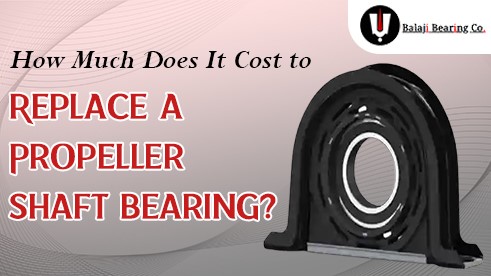
Mechanical machinery relies on the seamless transmission of rotational energy to perform work efficiently. In applications ranging from heavy manufacturing conveyor setups to specialized marine transportation and industrial packaging distribution lines, the drive assembly plays an indispensable role. At the heart of long drive lines is a component engineered to ensure stability, minimize friction, and control rotational harmonics: the propeller shaft bearing. Often referred to as a center support bearing or carrier bearing in automotive systems, or a cut less bearing in maritime machinery, this critical link provides structural tracking for spinning assemblies.
When a mechanical assembly shows signs of premature wear, physical deformation, or structural fatigue, understanding the total financial implications of replacement becomes essential for operations managers, procurement officers, and vehicle owners alike. Mechanical systems are highly interdependent; allowing a single damaged component to remain in continuous operation can trigger cascading catastrophic failures across adjacent components like universal joints, transmission output seals, and gearbox housings. In this practical analysis, we will demystify the direct and indirect replacement expenses associated with a propeller shaft bearing, breaking down hardware costs, operational labor variables, and systemic performance parameters.
Identifying the Role and Function of a Propeller Shaft Bearing
Before analyzing economic realities, it is vital to conceptualize what this component does and why its integrity dictates general machinery lifecycle length. Long metal rods, commonly known as drive lines or drive shafts, transmit high-velocity rotational torque from a motor, engine, or central prime mover over significant physical distances. Due to natural physical properties, as a long cylinder spins at rapid velocities, it experiences severe centrifugal stress and gravitational sagging. Without intermediate stabilization nodes, the spinning component would begin to bow outward, causing destructive harmonic shaking and rapid self-destruction.
The propeller shaft bearing resolves this operational vulnerability by serving as a mid-span tracking station. It securely wraps around the outer diameter of the spinning rod, absorbing high radial loads while keeping the rotating assembly aligned precisely along its long axis. In high-output manufacturing applications, paper mill conveyor systems, or packaging lines, these assemblies are surrounded by heavy molded rubber dampening cushions. This dampener acts as an structural isolation layer, absorbing high-frequency system vibrations and ensuring that mechanical sound doesn't transfer directly into the building frame or surrounding framework.
Financial Breakdown: The Direct Costs of Replacement
The complete financial investment required to fully repair or replace a propeller shaft bearing can be naturally segmented into two core categories: raw material hardware expenses and variable expert labor fees. For a standard light-duty industrial setup or standard transport truck, the general baseline cost typically spans from $250 to $750. However, for customized packaging automation systems, large material handling machinery, or massive maritime commercial hulls, these numbers can quickly escalate into thousands of dollars due to engineering specialization requirements.
Hardware and Component Material Pricing
The actual physical hardware itself is often the most cost-predictable part of the maintenance cycle. A basic replacement propeller shaft bearing assembly for a mass-produced industrial drive line or commercial delivery vehicle typically costs between $50 and $180. These standard kits usually arrive as an integrated unit comprising a premium-grade rolling-element ball bearing, a factory-sealed lubricant reservoir, heavy-duty dust slinger washers, and a pre-molded rubber isolation cushion house.
Conversely, when sourcing high-spec hardware for demanding environments—such as food processing lines requiring corrosion-resistant stainless-steel enclosures, or automated packaging equipment running continuous high-velocity shifts—the pure hardware price point may rise from $250 to over $600. In these specialized scenarios, purchasing just any generic replacement component is a recipe for rapid asset failure. Procuring certified components designed with optimal elastomeric dampeners and advanced triple-lip synthetic rubber seals is required to block fine packaging particulate dust or chemical wash-downs from penetrating the internal race lines.
Technical Labor and Engineering Service Fees
While raw hardware might look relatively affordable on a purchase order, the deep labor required to pull down a complex drivetrain system safely typically accounts for the majority of the total repair bill. Professional workshop billing rates generally fluctuate between $90 and $160 per hour, depending on your geographic location and facility specialization level. A standard mechanical replacement sequence requires anywhere from 2 to 5 hours of focused, precision-driven shop floor labor, translating to direct service fees ranging from $180 to $800.
The labor process is highly demanding because a technician cannot simply unbolt the worn part in isolation. The complete physical line must be methodically uncoupled from the transmission face, unbolted from the secondary differential flange, and fully extracted from underneath the machine frame. If a technician rushes this tear-down process or skips checking adjacent splines, it can easily lead to a faulty installation that damages the fresh propeller shaft bearing within a matter of hours.
Major Factors that Influence Your Repair Invoice
No two industrial facilities or fleet operations operate under identical conditions, meaning that baseline cost sheets must always be adjusted for local operational realities. The total funds needed to successfully replace a propeller shaft bearing are determined by four primary system variables:
- Machinery Scale and Fleet Class: Small logistics vans or compact packaging line sorters use lightweight, mass-produced components that are easy to source. Large heavy-duty manufacturing mixers, high-capacity cranes, or maritime tug configurations require custom-forged components with extensive material volumes, pushing up baseline component costs significantly.
- Drivetrain Layout Complexity: Multi-piece drive shafts require multiple support locations. If your primary manufacturing machinery relies on a three-piece system supported by twin intermediate structures, a failure in one node typically means the other has also suffered wear, doubling your overall component cost.
- Environmental and Sealed Enclosure Demands: If your operation handles abrasive mineral processing, harsh chemical packaging, or high-humidity manufacturing, standard off-the-shelf options will fail. Investing in high-performance specialty lubricants and synthetic fluoroelastomer seals increases upfront acquisition costs but lowers long-term operational expenses.
- Unplanned Facility Downtime Impact: In professional manufacturing environments, the true cost of an asset breakdown isn't just the invoice from the mechanic; it is the lost productivity of a halted assembly line. Emergency sourcing and expedited overnight delivery fees can quickly add hundreds of dollars to the base price of a propeller shaft bearing replacement.
Understanding the Cost of Neglect: Secondary Component Failure
Attempting to defer necessary maintenance on a loud or vibrating propeller shaft bearing is a dangerous strategy that inevitably inflates your long-term repair ledger. A compromised intermediate bearing loses its structural capability to isolate rotational harmonics, sending destructive energy spikes echoing down the entire drivetrain assembly.
Within a short window of continuous operation under these conditions, the extreme vibration will crack the delicate internal needle rollers within adjacent universal joints. This allows the heavy shaft to wobble violently, tearing open the transmission tail-shaft output seals and letting vital lubricating fluids drain completely. This can quickly turn a simple $400 preventative bearing service into a complex $4,500 replacement project involving completely ruined transmission cases or gearboxes. By monitoring system wear profiles and replacing your propeller shaft bearing at the first sign of degradation, you protect your broader capital investments.
To give procurement teams and maintenance managers a concise summary of what to expect during a routine repair cycle, the following table organizes baseline projections across common industrial and fleet configurations:
| Equipment / Fleet Category | Estimated Parts Cost | Estimated Labor Hours | Total Expected Cost Range |
|---|---|---|---|
| Light Commercial & Sorter Lines | $50 – $130 | 1.5 – 2.5 Hours | $200 – $450 |
| Heavy-Duty Haulers & Conveyors | $150 – $350 | 3.0 – 5.0 Hours | $450 – $1,100 |
| Specialized Manufacturing Assets | $400 – $900+ | Variable / On-Site Team | $900 – $2,500+ |
Technical Maintenance Symptoms to Monitor Closely
Operational profitability relies heavily on predictive insights rather than reactive responses. To catch a failing propeller shaft bearing before it triggers secondary systemic issues, operators should look out for these classic warning signs:
- Persistent Low-Frequency Cabin Thrumming: A deep, rhythmic vibration felt beneath the equipment floorboards that scales directly with operational velocity indicates that the rubber cushion has split or hardened.
- High-Pitched Squealing or Chirping at Low Velocities: If a dry metal scraping noise is heard during initial startup or slow movements, it indicates the internal grease reservoir has leaked, leaving the metal balls to run dry.
- Clunking Sounds During Acceleration or Load Engagement: When an asset transitions from rest to heavy load and produces an audible jolt, it indicates excessive mechanical play inside the central support framework.
- Visible Lubrication Splatters on the Underside Chassis: High-velocity rotation throws grease outward. Finding rings of black grease on the underside of your machinery confirms the integrated bearing seals have ruptured.
Conclusion:
Trust the Industrial Experts at Balaji Bearing India
Navigating industrial maintenance challenges requires relying on highly engineered components that deliver long-term dependability and absolute tracking accuracy. Balaji Bearing India stands as a premier manufacturing pioneer, delivering top-tier industrial bearing solutions that keep essential machinery running smoothly across the globe. Highly regarded for its deep technical expertise in heavy manufacturing, high-speed automated packaging, and harsh industrial environments, Balaji Bearing India produces meticulously engineered products designed to perform flawlessly under intense load and speed demands. Whether your operation requires a heavy-duty propeller shaft bearing replacement, customized support components, or specialized high-seal variants, they deliver robust, field-tested components tailored to your exact technical specifications. Partnering with Balaji Bearing India ensures your facility minimizes unexpected downtime, maximizes mechanical asset lifecycles, and maintains exceptional occupational safety standards.
 Balaji Bearing Co.